

You Are Not a Project
There is a particular kind of exhaustion that does not show up on any medical chart.
It is the tiredness that comes not from doing too much, but from the relentless, low-level effort of proving yourself — to the people around you, to the standards you have quietly internalized, and most persistently, to yourself. The effort of being just a little more capable, a little more polished, a little more indispensable before you allow yourself to believe that you belong. That you deserve. That you are, without qualification, enough.
You may not have named it. It may simply have felt like high standards, or conscientiousness, or drive. It may have felt like the reasonable response of a reasonable person in a world that rewards achievement, that sorts people by what they produce and what they accomplish and what they can demonstrate.
And yet underneath all the doing, there is often a question that never quite gets answered, because no achievement was ever designed to answer it. “What have I accomplished?” is not the question. The question, underneath all the doing, is: Am I enough, as I am, right now?
This article is about that question.
Not about how to answer it correctly, or what to say to yourself in the mirror, or which practices will eventually convince you that you are worthy. It is about something more fundamental: what wholeness actually is, why so many people spend a lifetime searching for something they have never actually lost, and what changes in a life when a person stops trying to become whole and starts recognizing that they already are.
Because here is what almost no one says clearly enough.
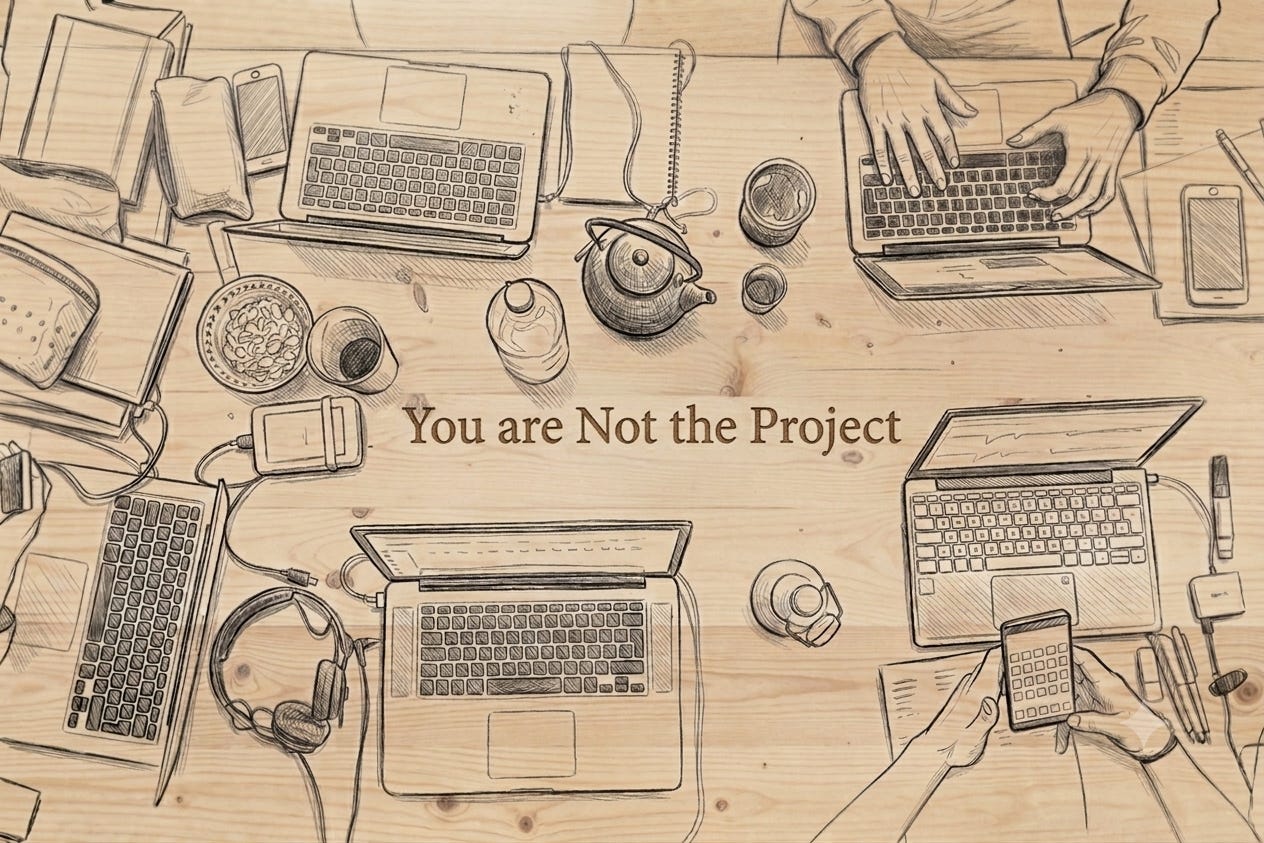
You are not a project.
You are not someone who will deserve love, success, and happiness once you have finally become the version of yourself you are always working toward. You were not born incomplete and handed a lifetime to fill in the missing pieces. The belief that you were and are somehow inadequate is not the path to wholeness. It is the primary thing standing in the way of it.
The machinery of manifestation, of creating a life that feels genuinely yours, does not run on achievement or effort or even virtue. It runs on what you believe about yourself at the level below words. And if that belief, quietly and persistently, holds that you are not quite there yet, not quite enough, not quite worthy of the full expression of what you most deeply want — then all the techniques in the world will have to work against the current of that underlying conviction.
Not because the universe is punishing you for not being enough. But because you are the one deciding what you are allowed to have.
It is time to look at that more carefully.
The Zombie in the Mirror
There is a reason the zombie will not leave our cultural imagination.
It appears in every form popular culture can produce — film, television, literature, games, art. Theorists have explained the obsession in many ways: fear of death, loss of individuality, the anxiety of conformity, the fragility of civilization. These explanations are not wrong. But they may be missing the more uncomfortable layer. The one that makes the image not just frightening but familiar.
The zombie is not dead. That is the detail worth sitting with. It is animate. It moves through the world, responds to its environment, pursues what it wants with singular focus. From a distance, in the right light, it can look like a person going about their day. What it lacks is not life. What it lacks is presence inside the life it is living. It is all motion and no witness. All behaviour and no awareness. The lights are on in the body. Nobody is home.
And the horror, the reason this image keeps returning across decades and across every medium that exists to tell human stories, is not really that zombies are threatening.
It is that they are recognizable.
The shuffling through routine. The automatic reaching for the familiar. The eyes that are open but not quite seeing. The conversations held on autopilot, the meals eaten without tasting, the days that pass without being inhabited. The life that is technically being lived but never quite felt from the inside.
Most people have whole days like this. Stretches of weeks. Occasionally longer periods they can barely account for afterward, not because anything terrible happened, but because nothing was truly met with presence. They were present in body and absent in every way that matters.
We understand the concept of lucidity in the context of night dreams. The moment in a dream when something shifts, when you suddenly know, from inside the dream, that you are dreaming. The landscape doesn’t change. The characters remain. But the quality of your presence inside it transforms entirely. Sometimes, in that moment, you find you can move through the dream with a new kind of awareness: deliberate, clear, no longer simply carried by it. More often, the recognition itself destabilizes everything. The dream wobbles at its edges. The landscape dissolves. You wake abruptly, or the lucidity quietly slips and the dream folds you back in as though the moment of clarity never came. The awareness was genuine. It was also fragile. Here and then gone. Which is, it turns out, exactly what presence in waking life feels like too — not a permanent state you arrive at and hold, but a signal that comes in and out of clarity, available in any moment and possibly gone again the next.
What we rarely acknowledge is that the same spectrum exists in waking life. Lucidity is not a binary — asleep or awake, zombie or enlightened. It is a dial that moves throughout every day, every conversation, every hour. You drift without noticing. Something brings you back. You drift again. The quality of presence fluctuates constantly, and most of it goes completely unexamined because unlike the night dream, there is no moment of waking up that announces — that wasn’t fully real either.
Here is what the zombie metaphor makes clear that softer images do not.
The zombie state does not damage what you are. The drifting does not diminish the wholeness underneath it. When you return to presence, in whatever small or large way that return happens: through a piece of music or a quality of stillness or a sentence that lands somewhere deeper than the mind, you are not recovering something that was lost during the drift. You are simply inhabiting, again, what was always there.
The return to genuine wholeness is not to add anything. It is to return to what was never actually gone.
That return is not dramatic. It rarely announces itself. It is simply the difference between moving through your life and actually being in it. And it is available in any moment as a practice of noticing when you have drifted and come back, again and again, without judgment and without drama.
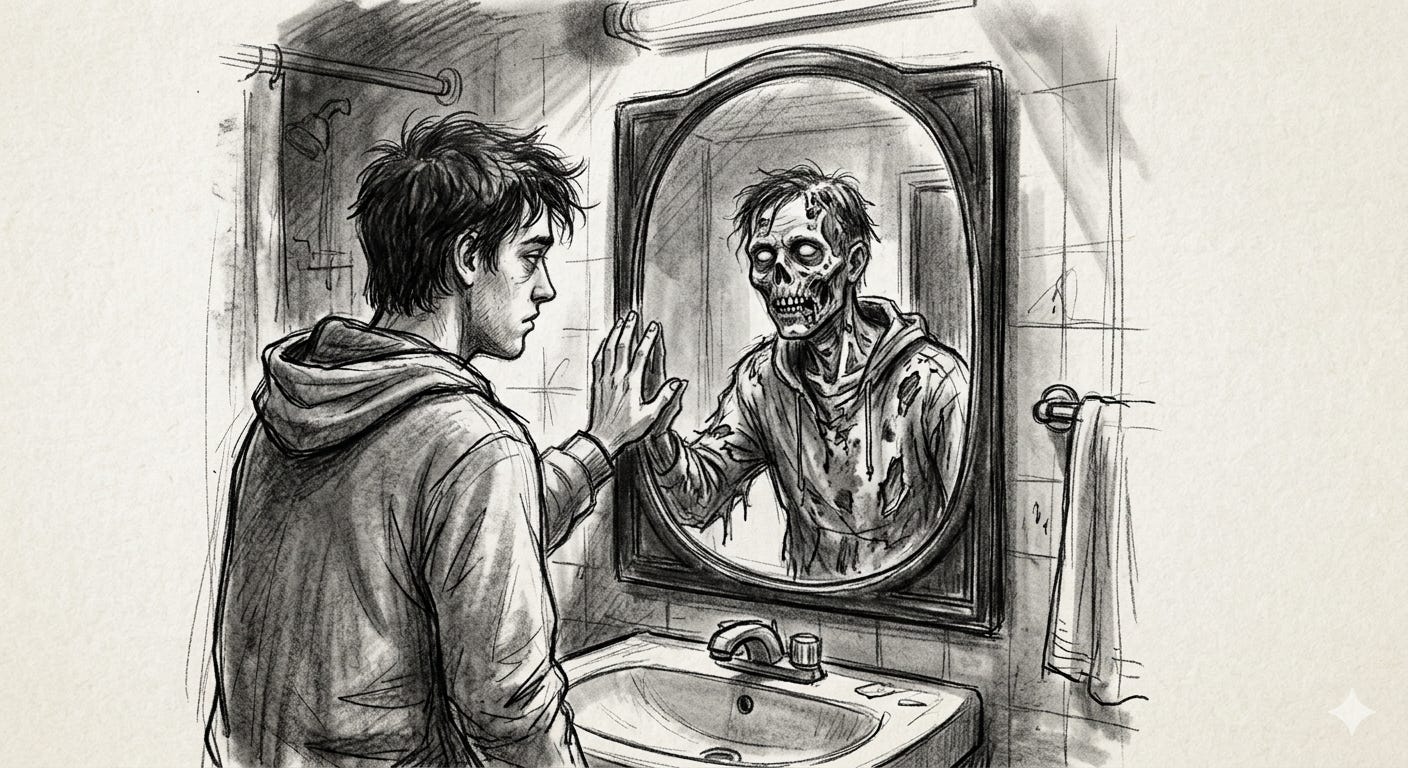
The zombie is not a monster from outside. It is a mirror. And the reason we keep making stories about it is that somewhere beneath the entertainment, we recognize the reflection, and sense, however dimly, that we were meant for something more awake than this.
I Am Worthy of Love, Success, and Happiness
This is perhaps the most quietly radical statement a person can make.
Not because it is unusual language; you have heard it before, possibly in contexts that made it feel like a feel-good platitude, easy to nod at but hard to actually inhabit; because of what it requires underneath the words; because of what it asks you to revise in the architecture of how you actually operate.
When you genuinely believe, not as an aspiration but as a present-tense fact, that you are worthy of love, success, and happiness, several things change that cannot be changed any other way.
One, you stop negotiating yourself downward.
This is one of the most consistent and least-discussed patterns in the lives of people who carry unworthiness beliefs. Not dramatic self-destruction but the quiet, socially acceptable version. The salary you accepted without negotiating because some part of you felt grateful just to be wanted. The relationship dynamic you tolerated because you didn’t feel quite entitled to ask for more. The opportunity you undersold yourself into, describing your work with so many qualifications and caveats that the other person adjusted their offer accordingly. The vision you edited before you spoke it out loud, shrinking it to a size that felt less presumptuous.
These are not signs of humility. They are the fingerprints of a worthiness belief doing its job — keeping your outer circumstances in alignment with your inner estimate of what you deserve.
Two, you also stop self-sabotaging at the threshold.
This is the pattern that bewilders people most when they see it in themselves. Everything goes well — genuinely well, better than expected — and then something happens. An argument that didn’t need to happen. A decision that made no rational sense. A sudden crisis of confidence at exactly the moment confidence was most needed. A choice that seems, in retrospect, almost engineered to derail the progress that was finally being made.
The sabotage is not mysterious. The subconscious is simply doing what it always does: maintaining the temperature the thermostat is set to. When outer circumstances rise above what inner beliefs have calibrated as the acceptable level of good, when the warmth in the room exceeds the setting on the dial, the system goes to work cooling things down. The self-sabotage is not a character flaw. It is a thermostat doing its job. And the only intervention that actually works is the one that happens at the level of the dial itself.
But there is a third shift that is perhaps the most important of all, and the least often discussed.
When you believe you are worthy of love, success, and happiness, you become genuinely capable of receiving them.
Receiving is a different skill than attracting. Many people who work with manifestation principles spend enormous energy on the attraction side: the visualization, the energy work, the alignment practices, and comparatively little on the receiving side. And so the opportunity arrives, real and freely given, and something in them cannot quite let it land. They deflect the compliment. They minimize the success. They find the flaw in the offer. They hold the gift at arm’s length, examining it for the catch, because somewhere beneath awareness runs the belief that gifts of this magnitude are not actually for people like them.
You cannot receive fully what you do not believe you deserve. The hand cannot stay open for what the heart is certain was sent to someone else.
Worthiness is not something you build toward. It is something you decide. Quietly, privately, in the interior where your beliefs actually live. The decision is available right now, without prerequisites, without the next accomplishment or the resolution of the outstanding flaw or the arrival of the relationship or the milestone that will finally make it feel safe to claim.
You are worthy. Not because you have proved it. Because you exist. That was always the only criterion that was ever real.
I Have Unique Gifts and Talents That the World Needs
Sit with this statement for a moment before moving past it.
Not the comfortable, polite version that you might nod at in a workshop and quietly file away alongside other things that sound nice but don’t quite land. The full version of it. The version that, if you took it seriously, would require a significant revision of how you think about yourself and your place in the world.
You have gifts the world actually needs.
Not gifts that would be nice to have expressed. Not potential contributions that might be appreciated by some people in some contexts if the conditions were right. No, a need, a genuine absence in the world that your particular combination of experience, perception, capacity, and inclination exists to fill.
Most people deflect this statement in one of two directions.
The first deflection is toward specialness anxiety, that is, the fear that claiming uniqueness is arrogant, that asserting your gifts are needed is grandiose, that the right posture for a decent person is modesty and the awareness of how much they still have to learn. This deflection sounds like humility. It is often something quieter and more corrosive: the decision, made long ago, that taking up space requires a justification you have not yet earned.
The second deflection is toward comparison — the immediate mental scan of people who have more gifts, or better gifts, or the same gifts more fully developed. The artist who compares herself to the masters before she has finished her first serious body of work. The entrepreneur who shrinks his vision the moment he considers the competitors already in the field. The person with a genuine insight who decides it isn’t worth sharing because someone else has probably already said it better.
Both deflections accomplish the same thing: they keep the gifts private. They keep the contribution theoretical. They protect the person from the particular vulnerability of showing up fully and being seen, which is, of course, the only way that genuine contribution ever actually happens.
The Web You Are Already Part Of
There is an image worth holding before we go any further.
Imagine a web. Not a small one, geometrically delicate that a spider builds between two branches overnight — but something vast. Something that extends in every direction beyond what the eye can follow. A living structure of threads so fine they are nearly invisible individually, yet collectively strong enough to hold everything that passes through them. Every thread connected to others. Every node, which is an intersection point where threads meet and cross, receives tension from the threads that run into it and transmits it outward through the threads that leave it.
Now imagine that one of those nodes is you.
Not metaphorically. Structurally. You occupy a specific intersection in this web that no other node occupies in quite the same way. The particular threads that run through you — the experiences that shaped you, the losses that opened you, the curiosities that have pulled you forward, the specific quality of attention you bring to the people and problems that most engage you — these create a node that is, in the most literal sense, unrepeatable. There is no other intersection in the web where exactly these threads cross in exactly this configuration.
Start with the intimate layer, because that is where the truth of this is most immediately visible.
Think of the people whose lives have been genuinely altered by something specific to you. The way you explained something that finally made it clear. The question you asked that no one else thought to ask. The thing you made or wrote or said that arrived at exactly the moment someone needed it, in exactly the form they could receive. The quality of attention you gave someone who had grown accustomed to being half-seen.
These were not accidents. They were your thread running through someone else’s node. And those people — changed, even slightly, by what only you could offer — went on to run their own threads through other nodes, carrying something forward that would not have existed without you. The web extended in that direction because you were present and willing to give what you specifically carry.
This is not grand. It is not the language of destiny or chosen ones. It is simply the quiet mechanics of how a web works. Every thread matters to the threads it touches. And the threads it touches carry that forward to the threads they touch. The effect of your specific gifts on the people immediately around you does not stop at those people. It travels. It compounds. It reaches nodes you will never see and could not anticipate, in directions the web has not yet grown.
Now expand outward.
If the human collective is understood not just as a population but as a web of souls: each one here to create experiences that deepen self-awareness, that stretch the capacity for love and understanding, that add new dimensions to what consciousness knows about itself, then the web is not merely social. It is alive in a different sense. Growing not just outward but inward. Becoming not just larger but more aware of itself.
In this frame, your gifts are not just useful. They are the specific contribution your node was placed in the web to make. The particular expansion of awareness that could only happen through your intersection, through your combination of wounds and wonder, your specific angle of vision, your unrepeatable way of meeting the world. When you express those gifts fully, you are not just helping the people around you. You are adding to what the collective knows about itself. You are extending the web into territory it could not reach without you.
And when you withhold them by editing yourself down, or deciding your thread is too thin or too ordinary to matter, when you wait for a more qualified version of yourself to show up before you contribute what you actually carry, the web does not collapse. It simply remains smaller than it was designed to be. The threads nearest your node bear more strain. The directions only you could extend the web into remain unreached. Not forever, perhaps. But for as long as you are absent from the place only you were shaped to occupy.
The web does not need you to be its most important thread. It needs you to be present. Tensioned. Willing to carry what runs through you outward to the nodes you touch.
That is all a thread is ever asked to do.
This is what the deflections miss entirely. Your gifts are not your gifts because they are the best in the web. They are your gifts because they are yours: which means they arrive through your specific lens of experience, your particular way of seeing, your distinctive way of being in relationship to the ideas and people and problems that most engage you. And that specificity is not a limitation. It is the point.
The mentor who changed your life probably wasn’t the most accomplished person in their field. They were the one whose particular way of seeing matched the particular way you needed to be seen at that moment. The book that opened something in you was probably not the most technically sophisticated treatment of the subject; it was the one written from an angle of experience that happened to intersect with your own. The solution that worked was not always the most elegant one in the abstract. It was the one that fit.
Your gifts fit somewhere, specifically. And when you understand that your place in the web is structural rather than decorative, something shifts in how the wanting feels. Your goals stop feeling like grasping and start feeling like expression. The success you are reaching toward starts to feel not like something you are taking from the world, but something you are giving to the world. The success is giving the full, genuine, undimmed contribution of what you actually are – offered to the nodes only you can reach.
That shift from wanting-as-taking to wanting-as-giving changes the emotional signature of your goals entirely. It replaces guilt with purpose. Anxiety with direction. The apologetic energy of someone who isn’t sure they should be here with the grounded energy of someone who knows, without drama, that their thread belongs exactly where it is.
The Soul That Has Never Been Broken
Beneath the worthiness questions and the gift questions, there is a deeper question that most people sense but rarely articulate directly.
What am I, actually?
Not in the biographical sense, not the accumulated record of what has happened to you, what you have done, what roles you have played. But in the essential sense. What is the thing that has been present through all of it, watching, experiencing, aware? What is the observer behind the thoughts, the awareness behind the feelings, the presence behind the persona?
In the spiritual traditions of both East and West, there is a consistent answer to this question: you are consciousness or awareness before you are anything else. Awareness before content. The screen before the images. And in that prior identity, you are, and have always been, entirely whole.
The body ages, accumulates injuries, eventually returns to the earth. The personality shifts across decades, shaped by experience, refined or distorted by circumstance. The beliefs, as we have seen, can be formed and reformed. But the awareness itself — the simple, steady, present-tense fact of experience — does not get damaged. It does not accumulate wounds the way tissue accumulates wounds. It does not age. It is not improved by success or diminished by failure. It is simply, and without interruption, here and now.
When you see yourself as a soul with a body, rather than a body with, perhaps, a soul, you are making a specific and significant choice about what you are fundamentally. You are placing your identity in what is permanent rather than what is conditional. In what is inherently complete rather than what is perpetually in progress.
This is not a metaphysical position you have to accept on faith. It is available as direct observation. Right now, in this moment, before any thought about your worth or your gifts or your past or your future, there is simply the fact of awareness. The thing that is reading these words. The thing that will be present for whatever happens next, as it has been present for everything that has come before. That awareness has not been diminished by any of your failures, and it will not be enlarged by any of your successes. It is already, completely, what it is.
Wholeness is not a destination. It is a recognition; quiet, direct, requiring no proof and no achievement, that recognition is the foundation on which everything else in manifestation actually rests.
You cannot sustainably build a life of genuine abundance on a foundation of unworthiness. You can achieve things from the unworthiness state. You can accumulate things. But you will find, as King Midas found, that the touch of someone who secretly doubts their right to hold good things has a way of converting what it holds into something that cannot be kept.
Foundation of recognition is solid. And solid means honest. And honest means resting your identity not on what you have managed to accomplish — which is always provisional, always at risk, always awaiting the next assessment — but on what you actually are, at the level that was never in question.
You are whole. Not as a destination. Not as something to become. As a present-tense, right-now, already-true fact about what you are beneath everything you have been told to believe you are.
What Changes When You Know This
The person who has genuinely settled into the belief that they are whole does not become passive; for they know they are worthy without condition, gifted without apology, a soul whose completeness is not dependent on circumstances. This is the misunderstanding worth addressing directly, because it is the one most likely to make wholeness feel like a threat to motivation or ambition.
The person who knows they are whole does not stop wanting things. They do not stop reaching, building, growing, or pursuing. What changes is the quality of energy underneath the pursuit.
Wanting from wholeness feels different than wanting from lack. Wanting from lack is contracted and slightly desperate; it has the quality of need, the tight vigilance of someone who knows that what they are reaching for is also what they require in order to be alright. Wanting from wholeness is expansive; it has the quality of expression, of a full river moving naturally toward the sea; not because it is escaping the place it came from but because flowing is what rivers do.
The goals do not become smaller when you know you are whole. They often become larger, because they are no longer being edited down to a size that feels appropriately humble for someone who isn’t sure they deserve them. The pursuit does not become less committed. It becomes less anxious, which makes it more effective — because effort that comes from genuine confidence is simply a different quality of effort than effort that comes from the need to prove something.
You also stop waiting.
This is perhaps the most immediate practical shift. The person who believes wholeness is conditional, that it is available once the achievement arrives, the wound heals, the missing piece is found, is always, in some quiet way, living in the waiting room of their own life. They are always a little bit in the future, where they will be more ready, more deserving, more settled into themselves. Not quite allowing themselves to occupy the present moment completely, because the present moment, as currently constituted, is not yet good enough to fully arrive in. You don’t hang pictures in a waiting room. You don’t make yourself completely at home. You sit, and you wait, and you expect that the real thing begins when your name is called.
The person who knows they are already whole arrives now. They bring all of themselves to what is actually here, not the carefully managed partial self of someone who is still in transit. And this, the full arrival in the present moment, is what makes the present moment come alive in the way it was always meant to.
The life you want is not waiting for you to become worthy of it. It is waiting for you to stop believing you have to become worthy of it first.
In Closing: The Return
The zombie state does not end with a single dramatic awakening. It ends the way all drifts end — with a moment of noticing. A quiet return. The lights coming back on, not all at once, but enough.
That is all that is ever required. Not a transformation into something you are not yet. Not an achievement of a level of worthiness you do not currently possess. Not the resolution of the outstanding issues or the healing of the remaining wounds or the discovery of the gifts you were not yet sure you had.
Only the return.
Permission to be, without condition, what you already are. Permission to take up the full space that was always yours to take up. Permission to want, openly and without apology, the life that calls to you. Permission to receive what arrives when you have aligned yourself with it, rather than sending it back with a quiet note explaining that there has been some mistake, that this level of good was clearly intended for someone else.
You are whole. Not as something to become. As something to return to — again and again, in every moment that you choose presence over drift.
And in that returning, in the quiet decision that the search for worthiness is over because what you were searching for was here all along, everything that has been straining upstream against your own doubt, held there without knowing it like water behind a dam, begins at last to move with the current instead.
This is not the beginning of a new project.
It is the end of a very old one.
You were always enough. The only thing that was ever missing was your willingness to stop arguing with it.
Stop arguing.
You are whole.


