

A Story About a Spreadsheet That Doesn’t Exist
At her ten-year reunion, Reyes ran into someone she barely remembered from freshman orientation. He asked how she was doing. She said: “Honestly? Kind of behind. I should be further along by now.”
He looked confused. He’d just spent the last twenty minutes hearing from others about her promotions, her second side business, the apartment she’d bought on her own, and a marathon she’d finished the year she also went through a divorce.
“Behind what?” he asked.
She didn’t have an answer. Not really. She had a feeling. And the feeling came from a ledger she’d been keeping her whole life. A ledger she’d never actually audited.
Almost everyone is running the same broken spreadsheet Reyes was. And almost no one knows it.
The Ledger You Keep Without Knowing It
There is a ledger most people keep throughout their lives, never once examining it.
It is not a ledger of facts. It is a ledger of meaning. On one side: everything that came through, landed, worked, and arrived. On the other: everything that didn’t. Every goal that fell short. Every door that didn’t open. Every version of the future assembled in the imagination, its parts still scattered in reality.
Most people, without realizing it, have learned to weight these columns unequally. The disappointments get full entries, studied and annotated, returned to regularly for review. The successes get recorded in lighter ink. Processed quickly. Set aside. Explained away with phrases like “I got lucky” or “that one doesn’t really count” or “I had a lot of help.” The wins are minimized not because they were small but because something in the way the ledger was originally set up decided that failures tell the truth about you while successes are exceptions to it.
This asymmetry is not accidental. It is learned. And it is, more than almost any other single habit of mind, the thing that keeps a genuinely abundant life from feeling like one.
This article is not about positive thinking, nor about training yourself to ignore the difficult entries in favour of the good ones. It is about something more honest and, ultimately, more useful: learning to read the ledger accurately. Because when you read it accurately, without the distortions of a mind habituated to scarcity, you find something unexpected.
What you find is evidence.
Evidence that things have worked. Evidence that opportunities have appeared, often at the moments they were most needed. Evidence that the capacity you doubted in yourself was present when it was called upon. Evidence, patient and cumulative, that something in the structure of your life has been more on your side than your anxiety has been willing to admit.
Abundance is not a future state to be achieved. It is a present-tense reality to be recognized. The question is not whether it exists. The question is whether you are willing to see it.
What Scarcity Actually Is
Before we can talk clearly about abundance, we have to look honestly at scarcity, because most people who believe they lack an abundance mindset think they know what scarcity is. They think it is the belief that there is not enough money, or not enough opportunity, or not enough love to go around. And those are real expressions of it.
But the deeper form of scarcity is subtler and more corrosive than any of those surface beliefs. The deepest form of scarcity is the belief that you are not enough. That somehow you are lacking and therefore cannot draw good things toward you.
This is not a belief most people would say out loud. It lives beneath the level of articulation, subtler than gravity, operating as a kind of atmospheric pressure on every decision, every pursuit, every moment of visible possibility. It is the thing that causes a person to hesitate at exactly the moment a door opens. To undersell themselves at exactly the moment full honesty would serve them. To scan a room full of opportunities and zero in, with unerring precision, on the one reason any given option might not work.
Scarcity is not a conclusion you reached after careful analysis. It is a lens that was handed to you, usually long before you were old enough to evaluate its accuracy, and that has been shaping what you see ever since.
The person with a scarcity lens sees fewer opportunities because they are not looking for them. Their attention has been calibrated to watch for threats, closings, and insufficiencies. They walk through the same world as the person with an abundance lens and arrive at genuinely different reports of what is there.
This is the mundane, well-documented reality of how selective attention works. We see what we expect to see. We notice what we have trained ourselves to notice. One could say the world presents the same movie screen to everyone; what each person projects onto it comes entirely from within.
Scarcity is a lens that can be changed, the way you change a pair of glasses, not by altering the world you are looking at, but by changing what you are looking through. But it cannot be changed until it is seen clearly for what it is: an accurate reading of the reality you have been building, and therefore evidence that a different reality is equally within reach.
Try This Tonight: The Five-Minute Audit
Before you read further, do this. It takes less time than the average doomscroll.
Grab your phone’s Notes app. Write two columns.
Left column: Every real loss from the last two years. Be specific. Right column: Every goal you set and actually reached, every door that opened when you needed it, every time the right person or resource showed up uninvited.
Most people freeze on the right column for a second because they’ve never been asked to look there on purpose.
Count both columns. Just count them. Don’t interpret yet.
The Track Record You Have Been Ignoring
Now look at the numbers.
What you have actually built has everything to do with the track record you have been keeping. So take a moment to examine your reality. Your track record is not a record of luck. It is a record of a world that has, more often than not, mirrored where you place your attention.
Most people, when they take an honest inventory of their lives, find more of a pattern of abundance: they have everything they need when they need it. The goal that seemed unreachable before it was reached. The opportunity that arrived at the exact moment the previous path had closed. The connection that appeared, apparently randomly, and turned out to change the direction of something important. The capacity that was not visible until it was needed, and then it was there.
These events are not equally distributed, and they are not without interruption. There are real failures in every genuine life, real losses, real stretches where the pattern went quiet. Taking inventory does not involve ignoring the hard chapters. But it is an invitation to count, with the same seriousness you have been counting the setbacks, all the chapters in which something worked.
People who count honestly find that the ratio is not what anxiety has been reporting. The failures are real and they are countable. But so are the successes. And the successes, examined clearly, do not look like accidents. They look like evidence. Evidence of a person who, when aligned and willing and genuinely in motion toward what they have in their heart, found that the world had something to offer them.
That is not a small thing. That is the whole foundation of a life built on genuine confidence rather than hope.
Confidence, real confidence, is the reasoned conclusion of a person who has looked honestly at their own track record and found, across enough instances, that they have been capable of more than their doubts have been willing to credit. It is earned, not performed. And it is earned specifically through the practice of taking your own history seriously.
When you set goals, and you look back, and you find that more often than not you have found a way to achieve them: that is not a coincidence. That is a pattern. And a pattern is information.
Abundance consciousness begins with taking that information seriously.
The Tuning Fork
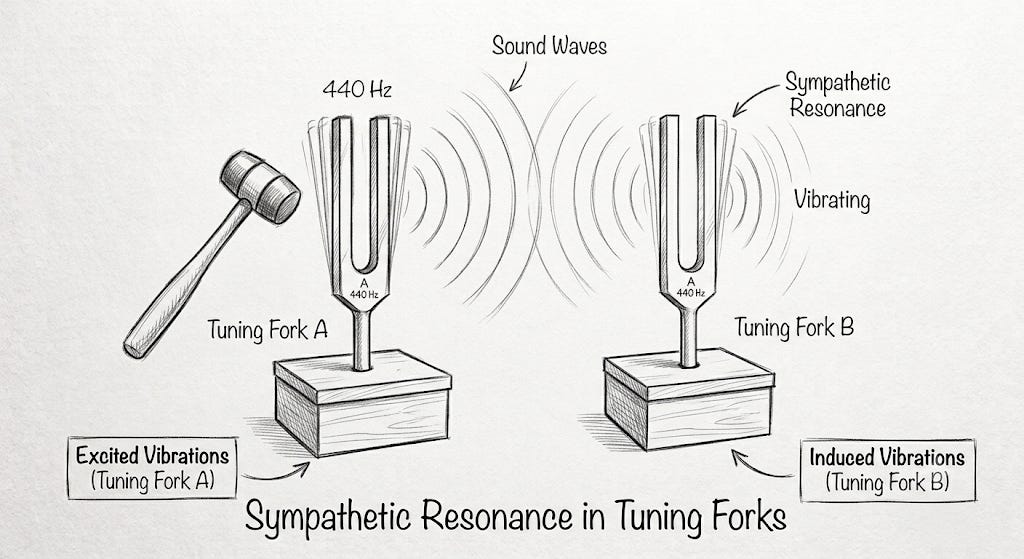
There is a principle in acoustics called sympathetic resonance. When you strike a tuning fork tuned to a particular frequency and hold it near another fork of the same frequency, the second fork begins to vibrate, not because it has been struck, but because the first fork’s vibration moves through the air between them and the second fork is built to respond to exactly that frequency. It was already designed to receive what was sent.
This is a useful image for how opportunity works.
Opportunities are not randomly distributed. They are selectively detected. And what determines detection is not primarily effort or talent or strategy, though all of those matter. What determines detection, at the most fundamental level, is attunement. What are you built to receive? What frequencies are you calibrated for? Your internal model of the world is the mental map you carry of how reality works. And that map, more than any other single factor, determines what you are able to detect.
The person operating from an abundance mindset is a tuning fork calibrated for a wide range. When they walk into a room, a conversation, a new relationship, a new industry, they are genuinely open to receiving signals from multiple directions. They are not scanning narrowly for the specific confirmation they need. They are available to what is actually there, which is very often more varied and more interesting than what was expected.
The person operating from scarcity is calibrated for threat. What they are built to receive, through long practice, is the signal that says not enough, not yet, not for you. And they find it everywhere, not because it is everywhere, but because they are exquisitely sensitive to exactly that frequency. They pick it up in a rejection that might have been a redirection. In a silence that was simply a silence, until scarcity decided otherwise. In a closed door that may have been protecting them from a room they did not actually need to enter.
This calibration becomes most visible at the precise moment an opportunity appears. Rather than meeting it with open attention, the scarcity-trained mind immediately scans for the catch. It reads for evidence that this isn’t real, that it won’t last, that you are not actually the right person for it. The scan happens quickly, automatically, and below conscious awareness. And in the time it takes to run it, the moment has often already shifted.
This is worth distinguishing from discernment, which is real and necessary. Not every door leads somewhere you need to go. Not every opportunity that presents itself is aligned with what you are actually building. The difference between discernment and scarcity-scanning is in the starting position. Discernment begins from a place of openness and asks: what is this, honestly? Scarcity-scanning begins from fear and asks: why won’t this work? The first leads to choices you can trust. The second leads to a life in which nothing ever quite lands.
The tuning fork does not create the vibration it receives. But without it, the vibration passes through undetected.
You are the instrument. The question is always: what are you tuned to receive?
What Your Goals Are Actually Saying
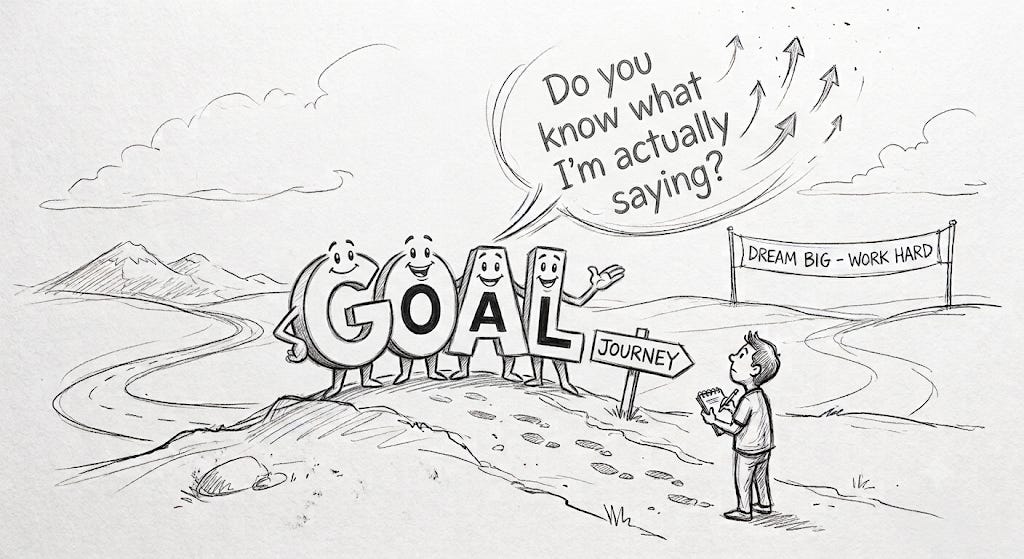
One answer to that question lives in something you have been doing all along, without fully recognizing what it was.
When you set a goal, something is happening that is more interesting than it usually looks.
You are not simply identifying a desired outcome and writing it down. You are making a declaration about what you believe is possible for you. You are doing something that requires, at least for the moment of setting the goal, the belief that the distance between where you are and where you want to be is crossable. That you have, or could develop, or could find, the capacity to cross it. That the world contains what is needed for the crossing. That you are the kind of person to cross that distances.
This is not a small belief. For a lot of people, even temporarily inhabiting it requires overcoming significant internal resistance.
But here is what the act of goal-setting also contains, nested inside it and rarely examined: the memory of every goal you have set and reached. The internal record of every version of this act, every time you stood at the edge of a distance and decided you were going to cross it, and then crossed it. Not always cleanly. Not always in the way you originally pictured. But reached, arrived at, done.
That record is alive in you. It is, in fact, the most honest evidence available about what you are capable of, and therefore about what the future contains. The past is not a wound only. It is also a demonstration. And what it has, over the course of a genuine life, demonstrated, is that you have moved. That you have touched things you reached toward. That the gap between desire and arrival has been crossed before, enough times and in enough different contexts, to constitute something more reliable than hope.
When you treat that record seriously, something shifts in the way new goals feel. They stop feeling like wishes and start feeling like plans. The evidence, honestly assessed, supports confidence in the movement. You have crossed distances before. The pattern is real.
And patterns, when they are real, are not just descriptions of what was. They are, carefully held and intelligently trusted, the most solid foundation available for what comes next.
Abundance Is
And here is what becomes possible once that foundation is genuinely in place.
Abundance is an emotional state. Not a circumstance you arrive at, not a milestone you cross. And like all the deepest states of being, it resists direct description. Every attempt to say what it feels like lands slightly short, because the moment you name the feeling you have already reduced it to a concept. What points more honestly toward it is not what it is, but what it is not. What falls away. What simply stops.
The vigilance stops. The low-level monitoring of what you have and what you might lose, the quiet background calculation of whether there is enough and whether you are keeping pace, goes quiet. Not because you have decided to stop worrying, but because the premise underneath the worry has lost its grip.
The comparison stops. Other people’s success ceases to register as information about your own position. It is no longer a subtraction. It is simply something that is happening in a world that contains more than enough, and it carries no message about you.
The resentment stops. The contracted, defensive posture of someone who believes good things are finite and must be protected loosens without effort. You are not practicing generosity. You are simply no longer organised around scarcity, and what people feel in your presence is the difference.
The question of whether there is enough stops arising. Not because you have answered it but because it no longer feels like a real question. The drought, as a felt reality, is over.
What remains when all of that falls away is not easily named. It is a quality of presence. An ease. An openness that has nothing to prove and nothing to protect. It is not something you perform or work toward. It is simply what is left when scarcity has nothing left to hold onto.
And that understanding, held consistently and expressed honestly, begins with the most private act available to you: an honest accounting of what has already arrived.
Before You Close This: Send It to One Person
Not everyone needs this today. But someone in your life is keeping the same rigged ledger Reyes was — quietly behind in a race that doesn’t exist, discounting a year that, counted honestly, was full of entries on the right side.
You probably already know who. Send them this line:
“You’re keeping score wrong. Read this before you decide you’re behind.”
In Closing: The Accurate Count

Go back to the ledger. Not the one weighted toward disappointment — the accurate one. The one that records entries in their actual proportions, without the distortion your old negativity-tuned brain installed before you were old enough to audit the installation.
Count what came through. Count the opportunities that showed up in forms you didn’t expect. Count the capacities that were there when you needed them, and the goals you reached — imperfectly, sometimes slowly, but reached.
Then look at what the count actually says: not that you’re lucky, not that the road’s been smooth, but that you are a person whose attention has been shaping their reality all along, and the world has been mirroring it back, faithfully, the whole time.
You’re not waiting to become abundant. You’re learning to recognize what was already here.
Audit your ledger. Check the weightings.
You are abundant.


